useState -React Hooks
React, the popular JavaScript library for building user interfaces, has witnessed a significant shift with the introduction of Hooks. Among these Hooks, useState stands out as one of the most fundamental and versatile.
The Role of useState in Functional Components
In React, state management is crucial for creating dynamic and interactive user interfaces. While class components have traditionally been used for state management, functional components have been gaining prominence, thanks in large part to the useState Hook.
useState is a Hook that allows functional components to manage local state. It’s a replacement for the this.state and this.setState approach in class components. With useState , state management becomes more straightforward and concise in functional components.
Understanding useState
To use useState, you need to import it from the ‘react’ library:
import React, { useState } from 'react';Code language: JavaScript (javascript)The useState function takes an initial state as an argument and returns an array containing two elements: the current state and a function to update it. The initial state can be of any data type, such as a number, string, object, or array.
Here’s a simple example of how to use useState to manage a counter in a functional component:
import React, { useState } from 'react';

function Counter() {
  // Declare a state variable 'count' with an initial value of 0
  const [count, setCount] = useState(0);

  return (
    <div>
      <p>Count: {count}</p>
      <button onClick={() => setCount(count + 1)}>Increment</button>
    </div>
  );
}
export default Counter;Code language: HTML, XML (xml)
Output :
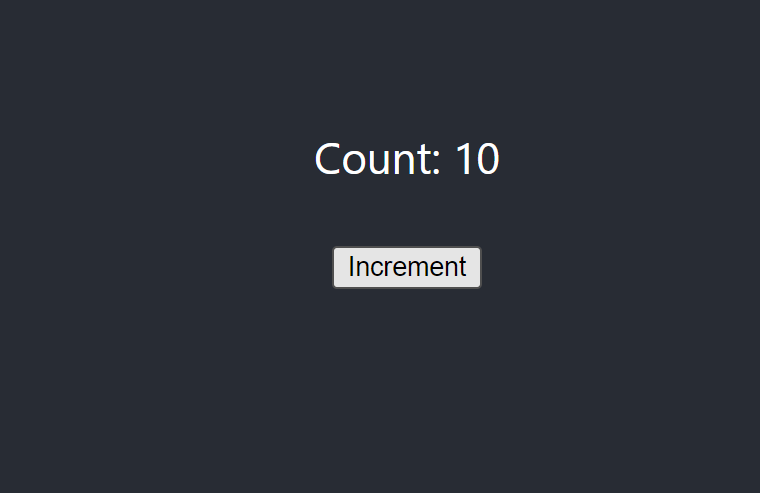
In this example, we declare a state variable count with an initial value of 0 using useState. We then render the current count and a button to increment it. When the button is clicked, the setCount function is called to update the state.
Updating State
In React, state is immutable, meaning you can’t directly modify it. To update state, you must use the provided state updater function, which is setCount in the example above. When setCount is called, it schedules a re-render of the component with the new state value. React then efficiently updates the DOM to reflect the new state.
Multiple State Variables
You can use multiple useState calls within a single component to manage multiple state variables. For example, you can manage the state of a username and an email input field:
import React, { useState } from 'react';

function UserForm() {
  const [username, setUsername] = useState('');
  const [email, setEmail] = useState('');

  return (
    <div>
      <input
        type="text"
        placeholder="Username"
        value={username}
        onChange={(e) => setUsername(e.target.value)}
      />
      <input
        type="email"
        placeholder="Email"
        value={email}
        onChange={(e) => setEmail(e.target.value)}
      />
    </div>
  );
}

export default UserForm;Code language: HTML, XML (xml)
Output :
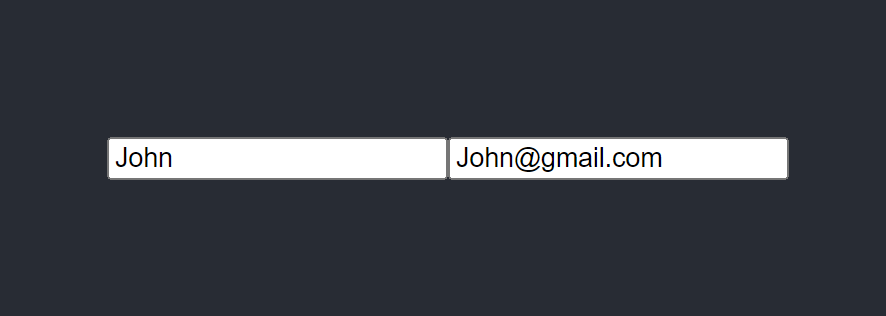
In this example, we use two useState calls to manage the state of the username and email fields in a user form.
Functional Updates
useState also allows you to use functional updates. Instead of passing the new state value directly to the state updater function, you can use a function that receives the current state and returns the new state.
Here’s an example of using functional updates to increment a counter:
import React, { useState } from 'react';

function Counter() {
  const [count, setCount] = useState(0);

  const increment = () => {
    setCount((prevCount) => prevCount + 1);
  };

  return (
    <div>
      <p>Count: {count}</p>
      <button onClick={increment}>Increment</button>
    </div>
  );
}Code language: HTML, XML (xml)
In this example, the increment function uses a functional update to increment the count. This approach is especially useful when the new state depends on the previous state.
Practical Use Cases
The useState Hook is versatile and can be used in a wide range of scenarios:
- Handling Form Input: Managing the state of input fields in forms.
- Toggling UI Elements: Controlling the visibility or behavior of UI components.
- Counters and Metrics: Tracking counts, scores, or other numeric values.
- UI State: Managing UI-specific state, such as the active tab in a tabbed interface.
Best Practices for useState
Here are some best practices for using useState effectively:
- Use Descriptive Variable Names: Choose variable names that reflect the state they represent. For example, use
countinstead ofx. - Keep State Close to Usage: Declare state variables as close as possible to where they are used.
- Use Functional Updates: When updating state that depends on the previous state, use functional updates to ensure correctness.
- Group Related State: If you have multiple state variables related to the same feature, consider grouping them in an object or using a custom Hook.
- Keep Render Logic Simple: Separate rendering logic from state management to maintain a clean and readable codebase.
Conclusion
The useState Hook in React brings a new level of simplicity and efficiency to state management in functional components. With `
useState, you can easily declare and update state variables, enabling you to build dynamic and interactive user interfaces. Whether you’re working on a small personal project or a large-scale web application, useState is a fundamental tool in your React development toolkit.
Related posts:

Powered by YARPP.