Lesson 6 of 7 · 5 min
Heap Sort
Discover the efficiency and stability of Heap Sort, a reliable in-place sorting algorithm with predictable performance. Learn how it works and where…
On this page
- The Basics of Sorting
- Understanding the Heap Data Structure
- Heap Sort: How It Works
- Step 1: Build a Max Heap
- Step 2: Heapify
- Step 3: Repeat Until Sorted
- Analysis of Heap Sort
- Advantages of Heap Sort
- Limitations of Heap Sort
- Use Cases for Heap Sort
- Comparing Heap Sort with Other Sorting Algorithms
- Implementing Heap Sort
- Conclusion
In the world of computer science, sorting algorithms are essential tools. They help us organize data efficiently, enabling faster search and retrieval operations. One such sorting algorithm is Heap Sort. It’s a reliable, in-place, and comparison-based sorting method that has stood the test of time. In this article, we’ll dive deep into the world of Heap Sort, exploring its principles, step-by-step execution, and its role in the realm of sorting algorithms.
The Basics of Sorting
Before we delve into Heap Sort, let’s briefly revisit the concept of sorting in computer science. Sorting refers to the arrangement of elements in a specific order, typically in ascending or descending order. It’s a fundamental operation used in various applications, from databases to search algorithms.
There are numerous sorting algorithms, each with its strengths and weaknesses. The choice of a sorting algorithm depends on factors such as the data’s size, distribution, and available memory. Heap Sort is a popular choice for its efficiency and stability in a variety of scenarios.
Understanding the Heap Data Structure
Before we explore Heap Sort, we need to understand the data structure that underlies it: the heap. A heap is a binary tree-based data structure, which can be categorized into two main types: Max Heap and Min Heap.
- Max Heap: In a Max Heap, the value of each node is greater than or equal to the values of its children. This ensures that the maximum element is at the root, making it useful for implementing Heap Sort.
- Min Heap: In a Min Heap, the value of each node is less than or equal to the values of its children. It’s suitable for applications where you need the minimum element to be readily available.
Heaps are often used for priority queues, but their underlying structure serves as the foundation for Heap Sort.
Heap Sort: How It Works
Heap Sort is a comparison-based sorting algorithm that operates on the principles of heap data structures. The basic idea is to build a max heap from the array to be sorted and then repeatedly remove the maximum element from the heap and place it at the end of the array. By doing this iteratively, you end up with a sorted array.
Let’s break down the Heap Sort algorithm into steps:
Step 1: Build a Max Heap
The first step is to build a Max Heap from the unsorted array. This is done by arranging the array elements into a binary tree structure and ensuring that the Max Heap property is maintained. The Max Heap property ensures that the maximum element is at the root.
Step 2: Heapify
Once the Max Heap is built, the next step is to turn it into a sorted array. This is achieved by repeatedly removing the maximum element from the root and placing it at the end of the array. This process is called “heapify.”
Heapify involves the following steps:
- Swap the root node (maximum element) with the last element in the array.
- Decrease the heap size by one.
- Restore the Max Heap property by sifting down the new root.
Step 3: Repeat Until Sorted
Repeat the heapify process until the entire array is sorted. As you heapify, the maximum element is continuously moved to the end of the array. After the final iteration, the array will be sorted in ascending order.
Analysis of Heap Sort
Heap Sort is a reliable sorting algorithm with several advantages and some limitations. Let’s analyze its key characteristics:
Advantages of Heap Sort
- In-Place Sorting: Heap Sort operates in-place, meaning it doesn’t require additional memory to store data during the sorting process. This is a valuable trait when memory usage is a concern.
- Stability: Heap Sort is a stable sorting algorithm. It doesn’t change the relative order of equal elements, making it suitable for scenarios where preserving the original order is necessary.
- Predictable Performance: Unlike some other sorting algorithms, Heap Sort provides predictable and consistent performance across different input data distributions. Its time complexity remains O(n log n) in the worst, average, and best cases.
Limitations of Heap Sort
- Not Ideal for Small Data Sets: Heap Sort’s overhead makes it less efficient for small data sets compared to simpler algorithms like Insertion Sort or Bubble Sort.
- Not Adaptive: The algorithm’s performance doesn’t improve if the data is partially sorted, unlike some adaptive sorting algorithms.
- Not as Common as Quick or Merge Sort: While Heap Sort is a robust sorting method, it’s not as commonly used as Quick Sort or Merge Sort in practical applications.
Use Cases for Heap Sort
Heap Sort is a versatile sorting algorithm with applications in various fields. Some of the use cases include:
- Operating Systems: Heap Sort is used in operating systems for tasks like scheduling processes. It ensures that high-priority tasks are executed first.
- Network Routing: In networking, Heap Sort helps determine the best route for data packets by sorting routing tables.
- Game Development: Game developers use Heap Sort for rendering objects in a certain order, such as by distance from the camera.
- Database Systems: Heap Sort can be employed to optimize certain database operations, such as creating sorted indexes.
Comparing Heap Sort with Other Sorting Algorithms
To appreciate the value of Heap Sort, it’s helpful to compare it with other well-known sorting algorithms:
- Quick Sort: Quick Sort is faster on average and in practice than Heap Sort. However, Heap Sort has a predictable time complexity of O(n log n) in all cases, making it more reliable for certain applications.
- Merge Sort: Merge Sort is also faster than Heap Sort in practice. However, Heap Sort uses less memory since it’s an in-place sorting algorithm.
- Bubble Sort and Insertion Sort: These algorithms are suitable for small data sets, whereas Heap Sort is better suited for larger data sets due to its O(n log n) time complexity.
Implementing Heap Sort
Let’s explore a simple Python implementation of the Heap Sort algorithm:
function heapify(arr, n, i) {
    let largest = i;
    let left = 2 * i + 1;
    let right = 2 * i + 2;

    if (left < n && arr[left] > arr[largest]) {
        largest = left;
    }

    if (right < n && arr[right] > arr[largest]) {
        largest = right;
    }

    if (largest !== i) {
        [arr[i], arr[largest]] = [arr[largest], arr[i]];
        heapify(arr, n, largest);
    }
}

function heapSort(arr) {
    const n = arr.length;

    // Build a max heap.
    for (let i = Math.floor(n / 2) - 1; i >= 0; i--) {
        heapify(arr, n, i);
    }

    // Extract elements one by one.
    for (let i = n - 1; i > 0; i--) {
        [arr[i], arr[0]] = [arr[0], arr[i]];
        heapify(arr, i, 0);
    }
}

// Example usage:
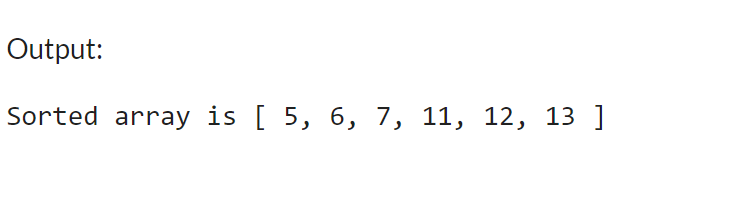
const arr = [12, 11, 13, 5, 6, 7];
heapSort(arr);
console.log("Sorted array is", arr);
Output :
Conclusion
Heap Sort is a reliable, in-place, and comparison-based sorting algorithm with a predictable time complexity of O(n log n). While it may not be the fastest sorting algorithm in all scenarios, its stability and predictable performance make it a valuable tool in various applications, particularly those where memory usage is a concern.
Understanding Heap Sort and its principles adds another tool to your sorting algorithm toolbox. Whether you’re a computer scientist, software developer, or simply a tech enthusiast, Heap Sort’s efficiency and stability make it an important sorting algorithm to explore and appreciate. It’s a testament to the beauty and versatility of algorithms in the world of computer science.
More from Data Structures and Algorithms
- Lesson 1 · 4 minWhat is DSA? Understanding Data Structures and AlgorithmsData Structure and Algorithm (DSA) is a branch of computer science that deals with the organization and manipulation of data in a computer. It is…
- Lesson 2 · 4 minComplexity analysis of Data Structure and AlgorithmsComplexity analysis of data structures and algorithms refers to the process of determining the computational complexity of a given algorithm or data…
- Lesson 3 · 4 minArray Data StructureAn array is a data structure that stores a collection of elements, each identified by an index or a key. The elements can be of any data type, such…